

Impact Crusher
Types and Construction of Impact Crushers
The impact crusher is also known as the impact breaker. Its classification is similar to that of hammer crushers. The different types are shown in Figure 1‑37.
The two rotors of a double‑rotor impact crusher can rotate in the same direction or in opposite directions. The twin rotors can be arranged at the same horizontal level or at different levels. The most commonly used type is the single‑rotor, non‑reversible, fixed‑hammer impact crusher. However, the application of double‑rotor impact crushers has also been increasing in recent years.
Figure 1‑38 shows a domestically manufactured φ1000 mm × 700 mm single‑rotor impact crusher. This type of crusher mainly consists of a housing, a rotor, and impact plates (or breaker plates). The electric motor drives the rotor through V‑belts. Material enters the crushing chamber (the space between the rotor and the impact plates) through the feed opening, where it is subjected to repeated impact and rebound between the blow bars (hammers) and the impact plates. The fragments are struck by the blow bars on the rotor and then thrown toward the second impact plate. A second crushing chamber is formed between the second impact plate and the rotor, and the above crushing process is repeated. In addition to the repeated impact crushing by the blow bars and impact plates, the material particles also impact and crush each other within the crushing chamber, and finally the crushed material is discharged from the lower part of the crusher.
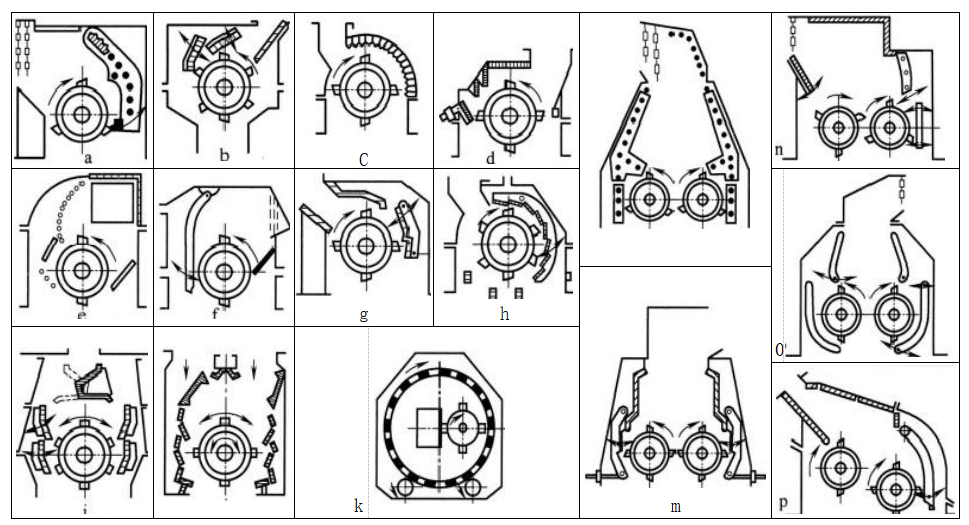
Figure 1‑37 Different types of impact crushers
a–h — Single‑rotor impact crushers;
i, j — Reversible single‑rotor impact crushers;
k — Impact crusher with discharge grate;
l–p — Double‑rotor impact crushers
In terms of structure and principle, the main differences between impact crushers and hammer crushers are as follows:
① The blow bars of an impact crusher are rigidly connected to the rotor, and the inertia of the entire rotor is used to impact the material. During crushing, the material not only gains high speed and kinetic energy and is crushed by impact against the impact plates, but also undergoes interparticle impact crushing between the material particles themselves.
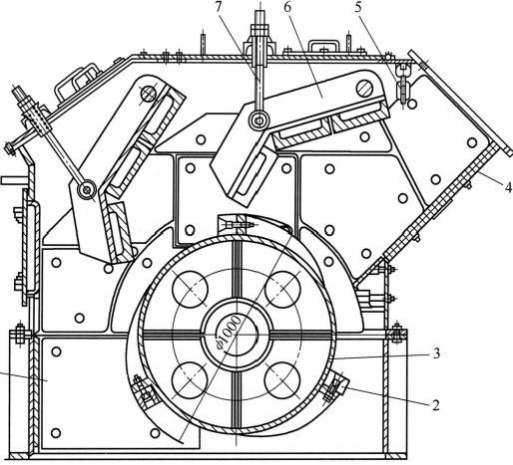
Figure 1‑38 φ1000 mm × 700 mm single‑rotor impact crusher
1—Housing;2—Blow bars (hammers);3—Rotor;4—Feed opening;5—Chain curtain;6—Impact plate (breaker plate);7—Pull rod (tie rod)
② The impact plates (usually two) of an impact crusher together with the blow bars form the crushing chamber. Under the impact of the blow bars, the material travels at high speed first into the crushing chamber formed by the first impact plate, where it is crushed, and then into the second crushing chamber for further crushing.
③ Impact crushers generally do not have grate bars or screen plates. The material is crushed repeatedly by the blow bars and impact plates. The product particle size is determined by the material properties, blow bar speed, radial clearance between the blow bars and impact plates, and the machine structure.
④ One end of each impact plate is hinged on the frame, and the other end is suspended on the frame by springs or pull rods. When an uncrushable object enters the crushing chamber, the impact plate is subjected to a high pressure and swings to a certain angle around its hinge, increasing the gap between the blow bars and the impact plate so that the foreign object is discharged. After that, the impact plate returns to its original position and normal operation resumes.
Impact crushers have the advantages of high production capacity, large crushing ratio, high crushing efficiency, light equipment weight, and uniform product size. However, when crushing hard or highly abrasive materials, the blow bars and impact plates wear severely. The blow bars and impact plates are commonly made of high‑manganese steel, high‑chromium cast iron, etc. Using 15Cr2Mo1Cu high‑chromium cast iron for impact plates to crush silica stone can increase the service life by 2 to 4 times compared with high‑manganese steel.
The structural shapes of the blow bars and impact plates in an impact crusher greatly influence the crushing performance. Commonly used cross‑sectional shapes for blow bars include rectangular, I‑shaped, T‑shaped, and S‑shaped. The surface shapes of impact plates are mainly of the folded‑line type (Figure 1‑38) and the involute type (Figure 1‑39). The latter offers higher crushing efficiency because the material impacts the impact plate surface perpendicularly at every point. In practice, impact plates built from multiple circular arcs to simulate an involute curve are sometimes used (Figure 1‑39).
The technical characteristics of domestically manufactured impact crushers are listed in Table 1‑22.
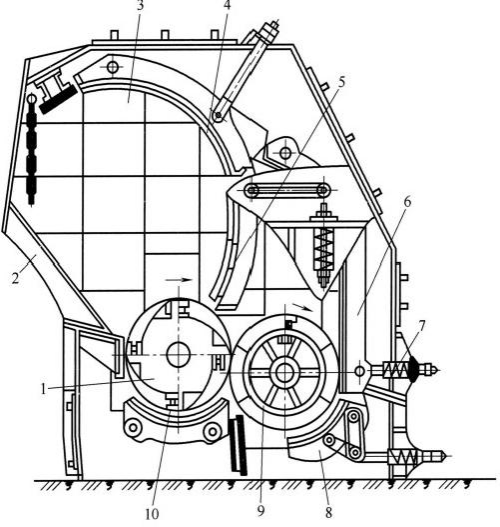
Figure 1‑39 φ1250 mm × 1250 mm double‑rotor impact crusher
1—First rotor;2—Feed opening;3—Housing;4—First impact plate (first breaker plate);5—Lower impact plate (lower breaker plate);6—Second impact plate (second breaker plate);7—Spring;
8, 10—Grate bars (screen bars);9—Second rotor
Table 1‑22 Technical characteristics of domestic impact crushers
| Specification (mm×mm) | φ500×400 | φ1000×700 | φ1250×1000 | φ750×500 | φ750×700 | φ1100×850 | φ1100×1200 | φ1250×1400 | φ1600×1600 | φ1250×1250 |
|---|---|---|---|---|---|---|---|---|---|---|
| Feed opening (mm) | 320×250 | 670×400 | 1000×550 | 520×350 | 720×350 | — | — | 1440×450 | 1645×500 | 1440×1320 |
| Max feed size (mm) | 100 | 250 | 250 | 80 | 80 | 80–200 | 80–200 | 80 | 80 | 800 |
| Product size (mm) | <20 | <30 | 50 | 80%<3 | 80%<3 | 80%<(3–15) | 80%<(3–15) | 80%<3 | 80%<3 | 90%<2 |
| Capacity (t/h) | 4–8 | 15–30 | 40–80 | 20 | 50 | 100 | 200 | 300 | 500 | 80–150 |
| Rotor speed (r/min) | 960 | 680 | 475 | 1470 | 1470 | 980 | 980 | 985 | 735 | 535/720 |
| Blow bar tip speed (m/s)* | — | 35.5 | 31 | 58 | 58 | 56 | 56 | 64.5 | 62 | 36/48 |
| Number of blow bars | 3 | 3 | 6 | 4 | 4 | 6 | 6 | 8 | 10 | 4/6 |
| Motor power (kW) | 7.5 | 40 | 95 | 30 | 75 | 130 | 240 | 380 | 625 | 130/155 |
| Motor voltage (V) | 380 | 380 | 380 | 380 | 380 | 380 | 380 | 6000 | 3000 | |
| Overall dimensions (mm) | ||||||||||
| Length | 1200 | 2170 | 3357 | 2141 | 2375 | 3204 | 3622 | 5697 | 4975 | 5200 |
| Width | 1000 | 2650 | 2255 | 1670 | 1670 | 2400 | 2400 | 2448 | 3080 | 2400 |
| Height | 1160 | 1850 | 2460 | 1470 | 1470 | 2280 | 2280 | 2088 | 2700 | 5000 |
| Machine weight (kg) | 1350 | 5320 | 13418 | 1869 | 2358 | 5400 | 7217 | 9048 | 14500 | 64000 |
Figure 1‑39 shows a domestically manufactured φ1250 mm × 1250 mm double‑rotor impact crusher. In this crusher, the two rotors rotate at high speed in the same direction, but they are arranged in a high‑low configuration (i.e., at different horizontal levels). The crushing chamber is relatively large, giving the crusher a high crushing ratio and high production capacity. It is mainly used in the cement industry for crushing medium‑hard materials such as limestone, and it can reduce limestone with a feed size of 850 mm to a product size of –20 mm (i.e., 100% passing 20 mm).
Applications of Impact Crushers
Impact crushers are extremely versatile. For example, various models of impact crushers manufactured by Hazemag (Germany) have been used in over 50 industries, including building materials, coal, ores, animal bones, food, waste, and plastics.
Stone quarried from mines, after being crushed by an impact crusher, can be used for road construction or for producing concrete. In addition, there are impact crushers specifically designed for producing manufactured sand from crushed stone.
When crushing asbestos ore, the process is sometimes carried out in two stages: in the first stage, the crusher rotor operates at medium speed to separate the asbestos fibers from the gangue; in the second stage, the rotor operates at high speed to liberate the fibers into individual units.
For crushing coking coal, where a fine product is required, an impact crusher equipped with grinding plates is often used. The crushed product contains 85–90% passing 2 mm and 40% passing 0.5 mm.
Special‑purpose impact crushers can be used for crushing domestic and industrial waste.