
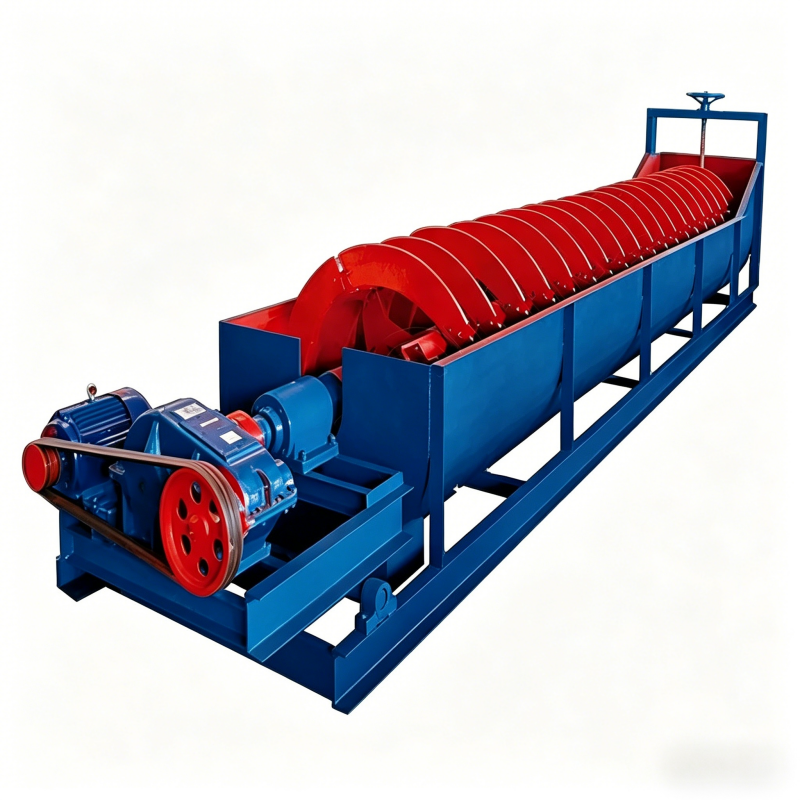
Spiral Classifier
The structure of a spiral classifier is shown in Figure 4-2. A double-flight spiral is installed inside an inclined semicircular metal trough, and the spiral is mounted on a hollow shaft. The upper end of the spiral shaft is supported by a bearing on a pedestal, while the lower end is supported by a specially sealed thrust bearing. A lifting mechanism can raise or lower the spiral. Figure 4-3 illustrates the working principle of the spiral classifier. The slurry is fed from one side of the lower end of the trough. Coarse particles settle to the bottom of the trough and are transported by the continuously rotating spiral to the upper end of the trough for discharge. Fine particles overflow from the overflow weir at the lower end. The spiral serves two functions: first, it transports the settled coarse material (sand), and second, it agitates the slurry to prevent fine or high-density particles from settling, thereby improving classification efficiency.
The specification of a spiral classifier is indicated by the spiral diameter. Based on the number of spirals, it can be classified into single-spiral and double-spiral classifiers. According to the height of the overflow weir, there are three types: low-weir, high-weir, and submerged types. In the low-weir type, the overflow weir is lower than the center of the bearing at the lower end of the spiral [Figure 4-4 (a)]. The settling zone area is relatively small, and the spiral agitation is relatively intense; therefore, it is used for coarse classification or ore washing operations. In the high-weir type, the overflow weir is located above the bearing at the lower end of the spiral, providing a larger classification zone area. The lower spiral blades are partially exposed above the slurry surface [Figure 4-4 (b)]. This type of classifier is suitable for medium-sized particles, with a classification size greater than 0.2 mm. In the submerged type, the overflow weir is even higher, as shown in Figure 4-4 (c), providing a large classification zone area, and the lower spiral blades are fully submerged in the slurry. This type of spiral classifier can achieve a very fine separation size and is suitable for fine particle classification, with a classification size range of 0.21–0.075 mm [4].
Figure 4-2 Schematic diagram of the spiral classifier structure
1—Settled sand (coarse product); 2—Top of the settling pool; 3—Conveying spiral; 4—Drive unit;
5—Overflow weir; 6—Lifting device; 7—Overflow