
Hammer Crusher
Types and Construction of Hammer Crushers
Hammer crushers, referred to simply as hammer mills, come in many structural types. Depending on the number of rotating shafts, they can be divided into single‑rotor and double‑rotor types; depending on the direction of rotor rotation, into reversible and non‑reversible types; depending on the number of hammer rows, into single‑row and multi‑row types; and depending on the way the hammers are mounted, into fixed and articulated types. A detailed classification of hammer crushers is shown in Table 1‑20 [17].
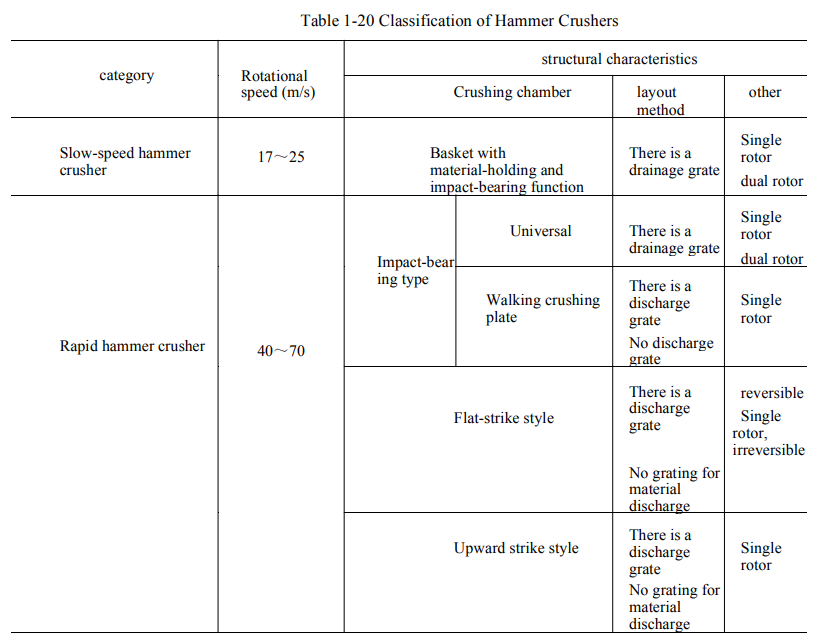
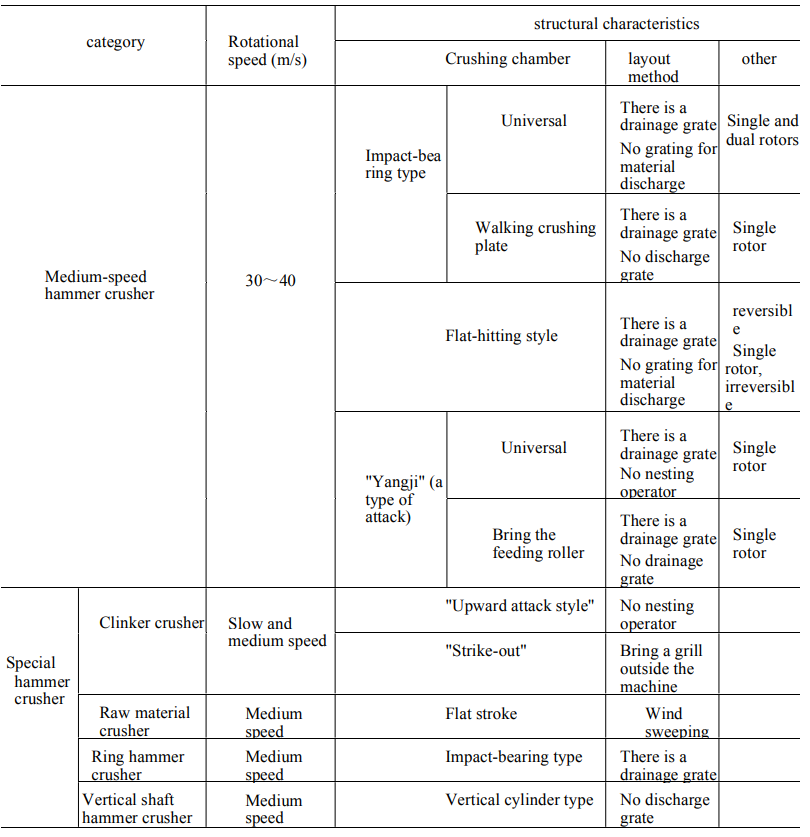
The most commonly used type in industrial sectors is the single‑rotor, non‑reversible, multi‑row, articulated‑hammer hammer crusher. General‑purpose hammer crushers are mainly used in cement plants, chemical plants, and other mining applications for crushing materials below medium hardness. Special‑purpose hammer crushers are used for crushing special materials such as steel scrap and waste.
Figure 1‑33 shows a single‑rotor, non‑reversible hammer crusher with a specification of φ1600 mm × 1600 mm, commonly used in large and medium‑sized cement plants in China. It consists of a drive part, rotor, bearings, grate bars, and housing.
The rotor is the main mechanism of the hammer crusher, composed of the main shaft, hammer supports (rotor discs), and hammers (heads). The main shaft supports the rotor of the crusher and must be made of a material with high strength and toughness (e.g., forged 35 MnMoV steel). The cross‑section of the main shaft is usually circular, sometimes square.
The hammer (head) is the working mechanism of the crusher and also the main wear part. It is typically made of high‑quality steel, high‑manganese steel, or other alloy steels (e.g., 30CrNiMoRe steel). The shape, size, and weight of the hammer must be properly designed. In addition to effectively crushing the material, the hammer should be usable in reversed orientations (top/bottom or front/back) after wear. The shapes of hammers are shown in Figure 1‑34. In the figure, hammers (a) and (b) can be turned four times (up/down/left/right) after wear; hammers (c) and (d) can be turned twice (left/right). Hammer (d) has a mass of 30–60 kg, and hammers (e) and (f) have a mass of 50–60 kg; these are used for crushing larger and harder materials. The mass of each hammer mounted on the rotor disc must be equal to prevent vibration during rotor rotation. When replacing hammers, the hammers in opposite positions must be replaced in pairs to maintain rotor balance.
The hammer support (rotor disc) is used to suspend the hammers. Although the hammer support itself does not crush the material, it often comes into contact with the crushed material and thus wears. Therefore, the hammer support is typically made of high‑quality cast steel.
The main function of the screen plate or grate bars is to control the product particle size; together with the rotor, they also form an arc‑shaped crushing chamber.
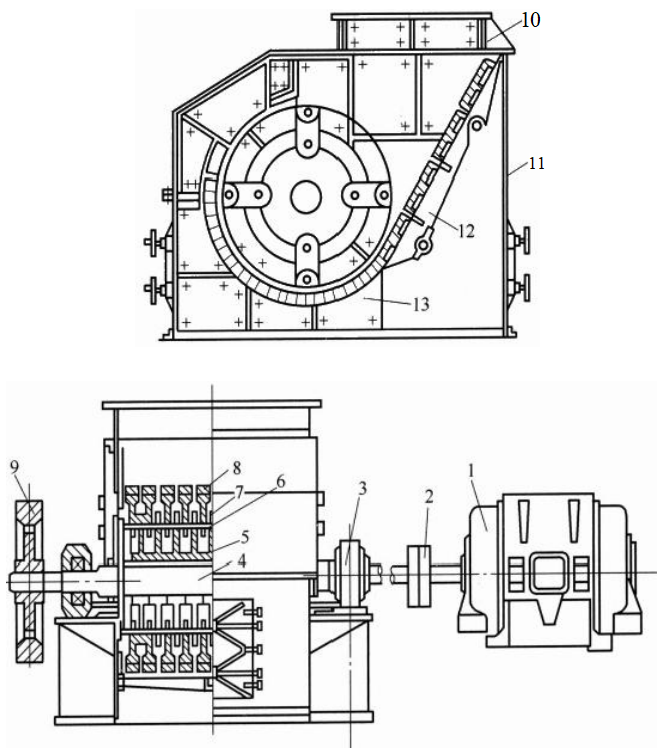
Figure 1‑33 φ1600 mm × 1600 mm hammer crusher
1—Electric motor;2—Coupling;3—Bearing;4—Main shaft;5—Disc (rotor disc);6—Pin shaft;7—Sleeve (spacer sleeve);8—Hammer;9—Flywheel;10—Feed opening;11—Housing (casing);
12—Liner plate;13—Screen plate (grate plate)
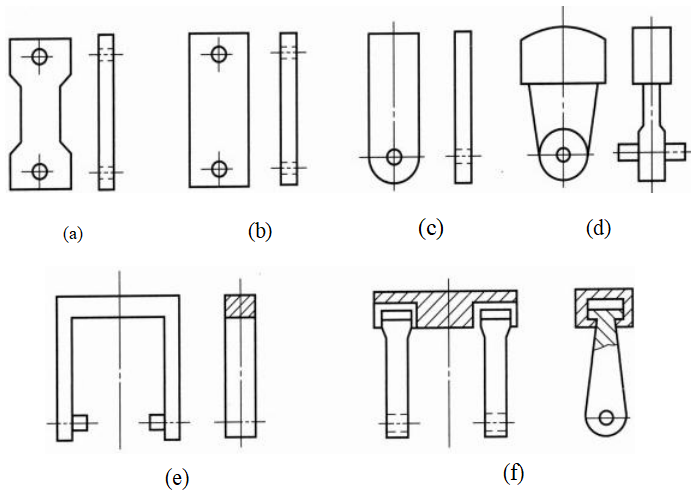
Figure 1‑34 Shapes of hammers
Qualified product is discharged through the screen openings (typically 10–20 mm). Material larger than the screen openings remains on the screen plate and continues to be crushed by impact and grinding from the hammers before being discharged through the screen openings.
The cross‑sectional shapes of the grate bars include triangular, trapezoidal, and rectangular forms.
The grate bars are also wear parts of the hammer crusher and are commonly made of high‑manganese steel or other alloy steels.
The arrangement of the grate bars is perpendicular to the direction of hammer movement and maintains a certain clearance with the rotor’s radius of gyration.
The screen opening size depends on the product particle size and the material properties. When crushing friable materials and producing a fine product, the screen opening size is selected as 3 to 6 times the maximum particle size of the crushed product; when crushing hard‑to‑crush materials and producing a coarser product, the screen opening size is selected as 1.5 to 2 times the maximum particle size of the crushed product.
When an uncrushable object enters the crushing chamber, because the hammers are articulated on the pin shafts and swing outward during rotation, upon encountering an uncrushable object the hammers can retract backward, acting as a safety device for the crusher.
The non‑reversible hammer crusher has a serious drawback: the hammers tend to wear on one side only. To turn the hammers over for reuse, the crusher must be stopped, the hammers removed, and then reinstalled reversed. This consumes a lot of time, wastes labor, and reduces the operating rate. To overcome this drawback, many industrial sectors use reversible hammer crushers, as shown in Figure 1‑35. The specifications and basic parameters of the single‑rotor reversible hammer crusher are listed in Table 1‑21 [18].
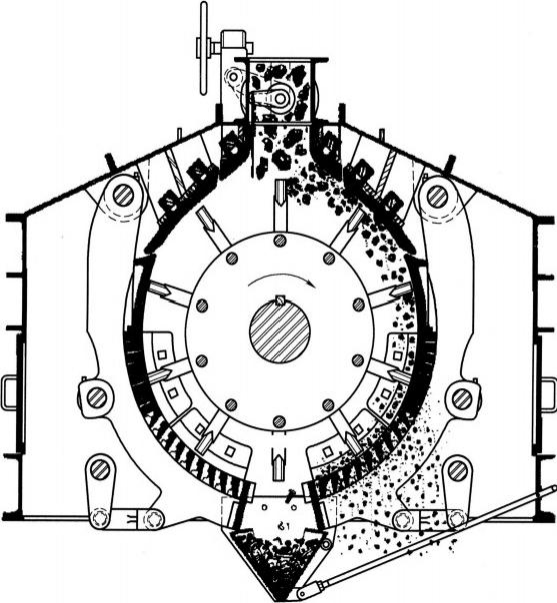
Figure 1‑35 Reversible hammer crusher (image courtesy of Pennsylvania Crusher)
Table 1‑21 Specifications and parameters of single‑rotor reversible hammer crushers
| Rotor dia. × length (mm) | Capacity (t/h) | Motor power (kW) | Material | Feed size (mm) | Product size (mm) |
|---|---|---|---|---|---|
| 1000 × 1000 | 75 | 75–110 | Coal | 100 | 10 |
| 1200 × 1200 | 120 | 90–160 | Coal | 100 | 10 |
| 1400 × 1400 | 150 | 200–355 | Coal | 100 | 10 |
| 1400 × 1800 | 250 | 355–710 | Coal | 100 | 10 |
| 1600 × 2200 | 400 | 500–800 | Coal | 100 | 10 |
| 1600 × 2600 | 500 | 560–1000 | Coal | 100 | 10 |
| 1600 × 3000 | 600 | 630–1250 | Coal | 100 | 10 |
| 1600 × 3400 | 800 | 750–1400 | Coal | 100 | 10 |
MAMMUT Hammer Crusher
Cement plants require that large lump raw materials be reduced to mill feed size in a single crushing stage. The MAMMUT single‑rotor hammer crusher manufactured by ThyssenKrupp (Germany) was designed precisely for this application.
The structural feature of this crusher (Figure 1‑36) is the presence of an impact plate near the feed opening. The function of this impact plate is similar to that of an impact crusher, so it can be called an “impact‑hammer crusher”. It uses short, heavy hammers that can rotate around their pivot pins. When crushing an oversized material lump whose weight exceeds the crushing capacity of the hammer, the hammer rotates backward while impacting, thereby providing a protective function. When crushing wet or sticky materials, the impact plate is equipped with an external heating device to prevent material adhesion.
This hammer crusher is used for crushing medium‑hard and tough materials such as limestone, marl, dolomite, gypsum, clay, and rock salt. It offers advantages such as energy savings, simplified crushing process, and reduced equipment and capital investment. For example, limestone with a feed size of 600–700 mm can be reduced in a single stage to 0–25 mm with 95% passing, which can then be fed directly to a tube mill. Equipment and capital investment are reduced by half, and the crushing energy consumption is only about 1 kW·h/t.
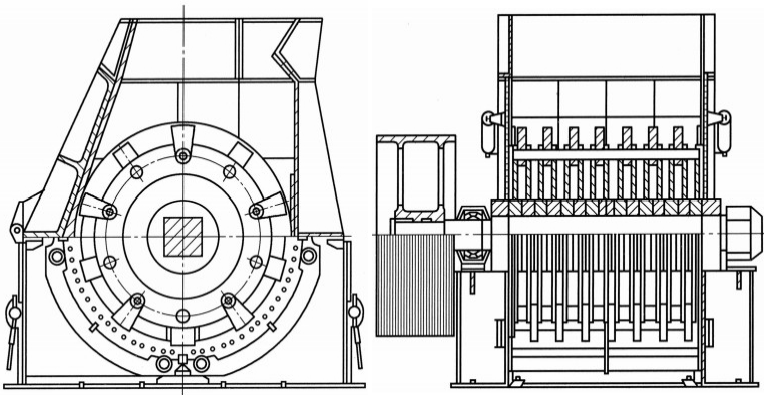
Figure 1‑36 MAMMUT hammer crusher
Applications of Hammer Crushers
Hammer crushers are used for crushing various medium‑hard and low‑abrasiveness materials. In large and medium‑sized cement plants in China, the single‑rotor, non‑reversible φ1600 mm × 1600 mm hammer crusher and the single‑rotor, reversible φ1430 mm × 1300 mm hammer crusher are commonly used. They can reduce limestone with a feed size of 350–400 mm in a single stage to 95% passing 25 mm, which is then sent directly to the grinding system. Small cement plants use models such as φ1000 mm × 1000 mm and φ1000 mm × 800 mm, or even smaller sizes.
In coking plants, hammer crushers are used for coal crushing. For example, a single‑rotor hammer crusher (with a hammer tip speed of 30–50 m/s) can crush coal to 85% passing 3–15 mm. The capacity of each unit varies with size, typically reaching 100–200 t/h or more.
Because hammer crushers have a certain mixing and self‑cleaning action, they can be used for crushing organic materials containing moisture and oil, such as animal feed, bones, and in the production of fish meal.
Hammer crushers can crush clay used in the building materials, ceramics, and refractory industries to a size of 0.06–5 mm. Special‑purpose hammer crushers can also be used for crushing metal chips, etc.